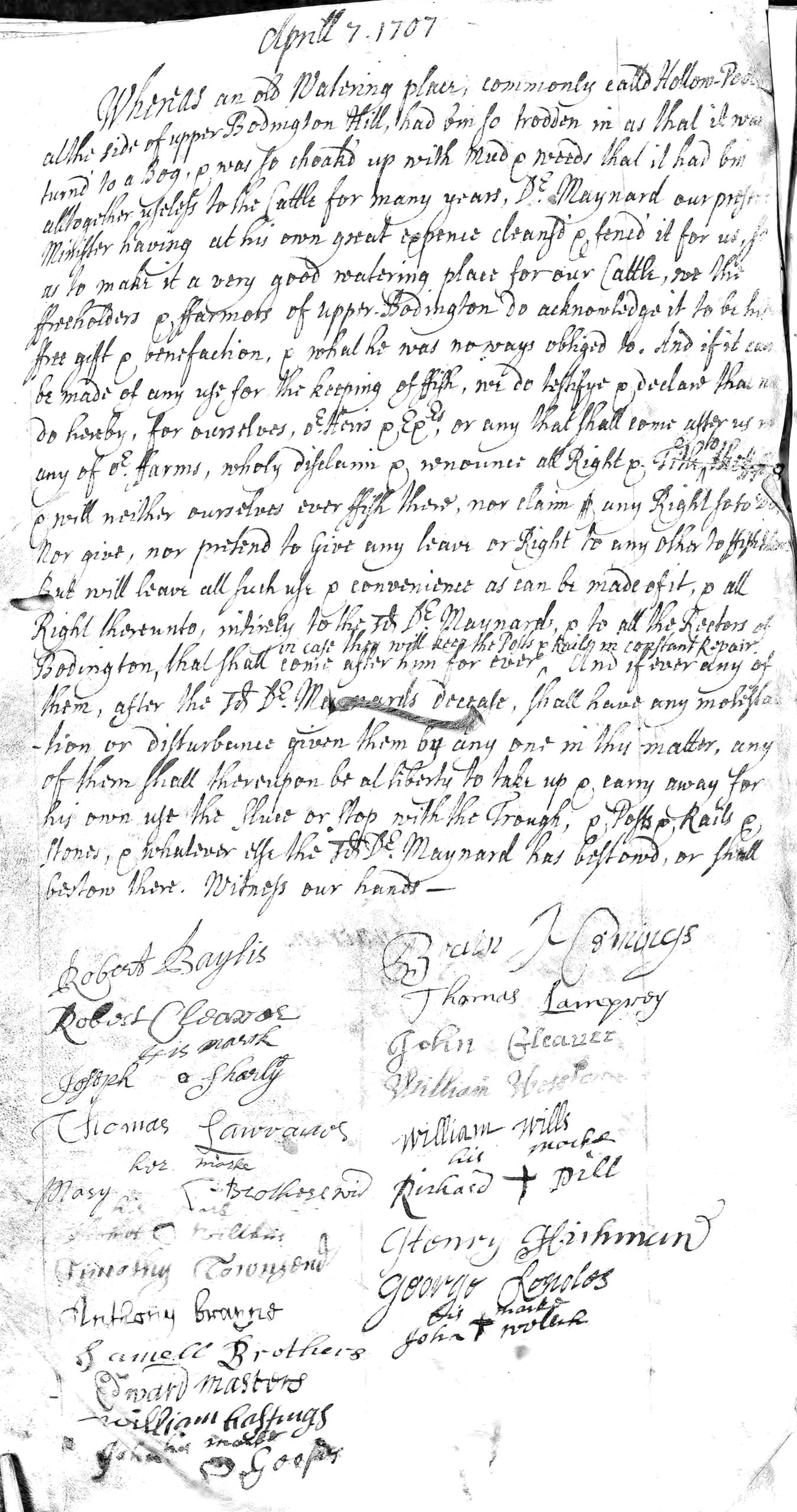
The first Boddington parish register has beautifully clear handwriting and starts reasonably early in 1558 and continues until 1707. Apart from the usual entries of christenings, marriages and burials there are about 20 pages of information at the back of the register. Four or five are pages of notes relating to the vicar who, in the early 1700s, had paid for various works around the parish which improved the lot of his flock. For example, he paid for some drainage around the village pond which made it much more usable. He appears to have been keen to ensure that the prominent citizens of Boddington fully appreciated his generosity by getting all freeholders and farmers to sign a note describing the works and assuring the vicar that they would not expect him to repeat this funding. This happened on three occasions: 1702, 1706 and 1707.
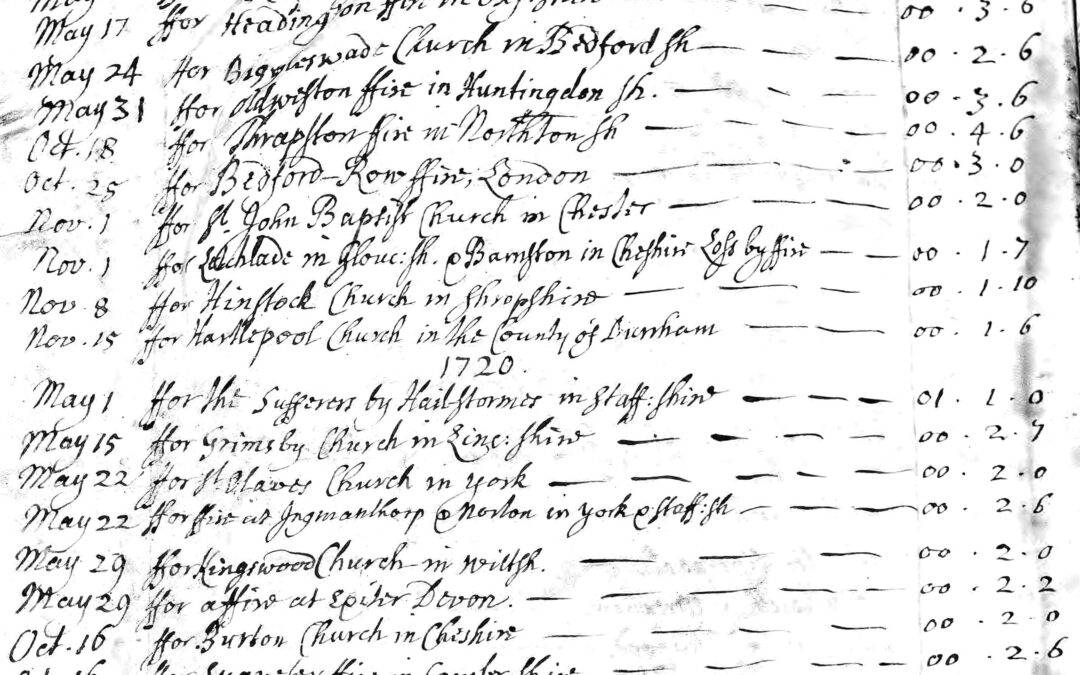
However, my real interest was sparked by the other pages at the back of the register, which relate to collections made from the congregation in aid of other communities, which had befallen some misfortune. The communities were spread far and wide, and not just England, Wales, Ireland and Scotland, but to Copenhagen, Denmark, and Oberbarmen church in Germany and ‘the churches of Poland and Russia’. The dates covered by these collections are from 1706 to 1732.
Now I started to think about how these ‘bad luck’ stories came to be told to a small village deep in the Northamptonshire countryside. Obviously, there must have been communication (a letter?) from the mother church in Lincoln or Peterborough, but then to include far off towns and countries that none had even heard of is quite astounding to me. Were vicars asked to pass a notice on to other parishes within their hundred? Or did each parish get a letter/notice about the latest cause? The printing press was well used for some things but did the church issue so many notices? The Boddington parishioners were a generous band often donating, in consecutive weeks, in excess of 4 shillings which is £72 at today’s equivalent (the value of £1 in 1700 is around £150). The biggest single collections were:-
- in November 1707 for ‘a fire in Southam’ £3.11.6d;
- in May 1726 ‘fire in Buckingham’ £2.5.6d;
- in May 1720 ‘a hailstorm in Staffordshire’ £1.1.0d;
- in November 1709 ‘for the Palatines’ £1.1.11d.
One of the smallest amounts collected was 10d (4 new pence) and that was on 25th May 1707 “for Wakelin’s loss by fire at Hurley Green, Staffshire”. I wonder if that 10d ever got to Wakelin
Interestingly, cheques were in use from the late 1600s, but would they be in use in small villages miles from any large trading centre? Vicars were usually educated at one of the ancient universities and perhaps managing their finances was part of their training. Would a vicar issue a cheque for 10d? If not, how would the money collected for those parishes and villages based in far off Europe be accounted for? One can visualise a courier on horseback carrying a pouch of money through the narrow lanes, on a mission to pass on the collection for the right cause, but did that really happen? Or perhaps they might get robbed on their way to the big town!
How did churches in Poland and Russia get their 13s? How did Copenhagen get their 7s 9d? How did Oberbarmen get their 3s 6d? Looking back at the larger collections shown above I checked out the hailstorm in Staffordshire. The National Archives have a document, which lists the ‘sufferers in hailstorm in Staffordshire’! But that was in 1722/3 rather than in 1720. It seems that Staffordshire was rather prone to such events.
Another weather event in 1722 had a collection on 18th November for “Brighthelmston inundation in Sussex 3s 2d” This appears to be the old name for Brighton as we now know it. Was this a tidal surge that we have become so familiar with in 2014? 17th May 1724 saw a collection made for “inundation in Halifax, Yorkshire 2s 7d. In 1715 a collection was made for “cowkeepers brief 11s 3d”. What on earth could that mean, I wonder? In 1712 a collection was made for an individual “Richard Salter’s loss by fire London 2s 3d” Most collections appear to be to help recover from fires, but some were to help out where some town was suffering from economic stress; 15th May 1726 saw 2s 6d collected for “Folkestone fishery in Kent”. “St Andrews harbour in Scotland” had 1s 3d collected on 27th October 1728.Whilst most of the collections were relatively small some appear to be larger than expected, the story told of this weeks’ latest catastrophe must have swayed the congregation into putting their hands in their pockets rather deeper than they could afford. The story of the cowkeeper’s brief must have been heart-rending and the fire at Southam, a local town known by many of the villagers, must have been ‘personal’ in the detail. Parish registers usually tell us little if anything about the community that they record, but here we can see that one small village really did care about their fellow man, and counted their blessings for being so fortunate.
AM Feb 2026