

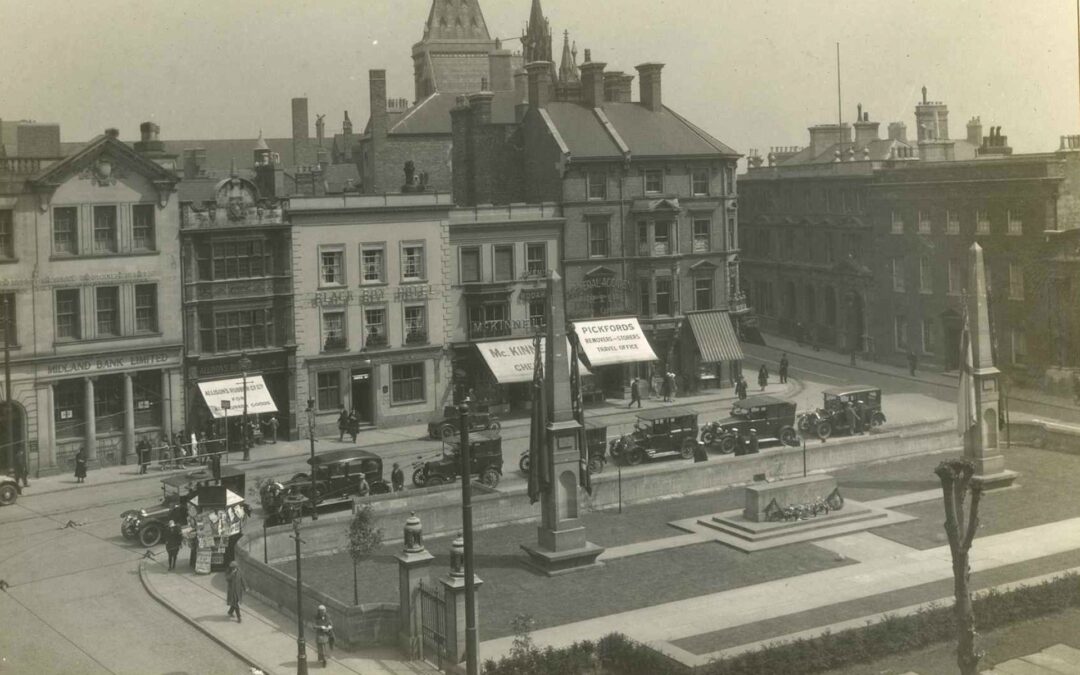
Image above © National Archives
No sooner had the Armistice been signed than the editorials of the local newspapers started talking about memorials. The Northampton Independent on 23 November stated that ‘there was a sacred obligation to discuss and decide on the form of the memorials. And, the scheme should be one in which every parish could join otherwise there would be a separate memorial fund in every village and a hideous eruption of brasses, drinking fountains and useless eyesores’. Of course, this suggestion was very much ‘town based’ and did not consider the feeling of the people in the county villages who wanted a memorial of their own where they could go and remember lost loved ones.
Predictably there was a flurry of response letters in the following week’s paper. This included suggestions for the removal of the fountain on the Market Square, new buildings in memorium should include a good restaurant or tea rooms, a new market hall, ‘particularly one that could be used by farmers as well as ordinary townspeople’. Or perhaps some Turkish baths and a swimming pool’.
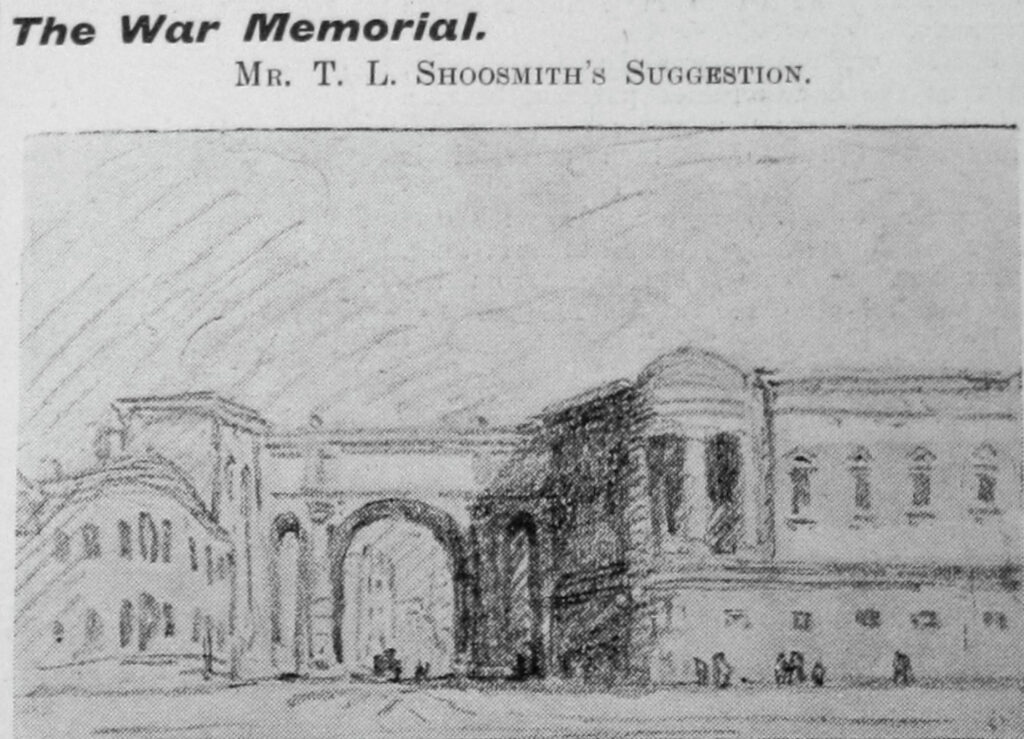
Local architects, perhaps with an eye on the chance to have their design chosen began to draw up plans for what they thought was suitable. This design, by Thurston Shoosmith appeared in the Independent for 4 January 1919 – this is for a memorial arch across the top of Guildhall Road with the frontage along St Giles Square being used as the approach to a Memorial Hall or other suitable building, The Editor thought it ‘too exotic’ to appeal to Northampton and he wondered if a commanding crescent facing the Guildhall with a town square containing an imposing monument leading up to a Temple of Remembrance would be more suitable.
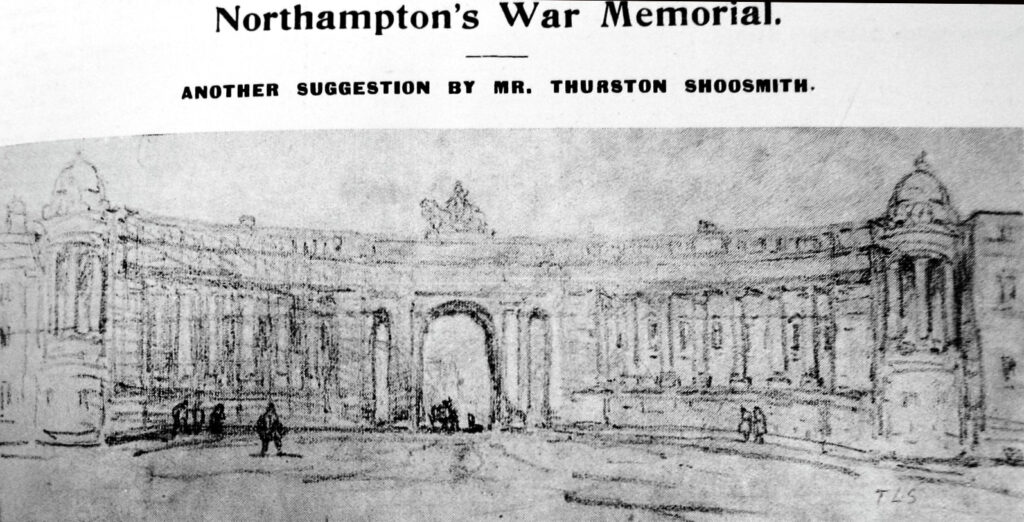
The following week, Shoosmith’s design for a crescent was published. ‘A majestic, noble design to command much admiration’. However, to realise this scheme, all the property along St Giles Square and the top of Guildhall Road would have to be removed.
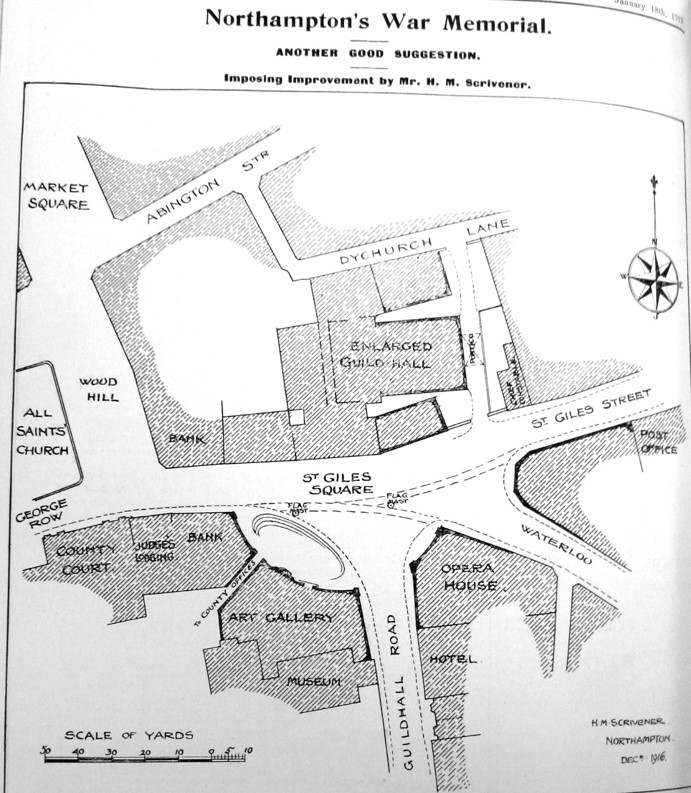
Yet again another suggestion was published on 18 January, this time by Mr Harold Scrivener, well known architect of Northampton. The main idea is the enlargement of the present town hall to accommodate 3000 people and a new thoroughfare alongside the Chief Constable’s home through to Dychurch Lane.
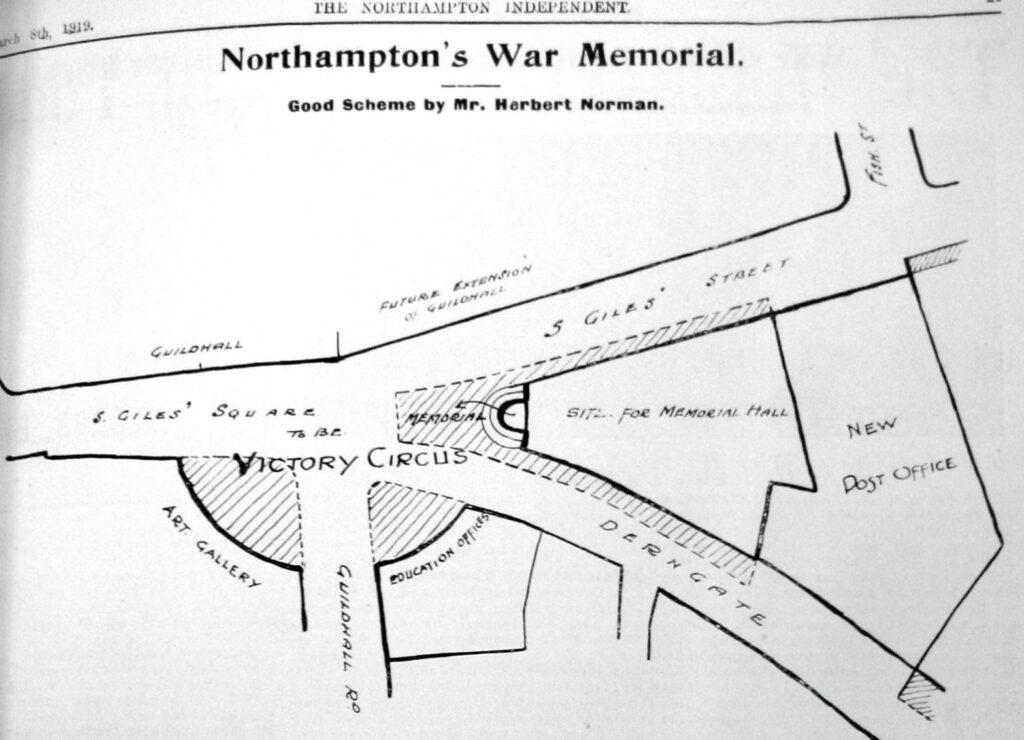
And another , just as radical suggestion was published on 8 March from Mr Herbert Norman, who also suggested that the whole of the property in St Giles Street from the Prudential Offices to the Post Office should be pulled down and the street widened. Likewise to the top end of Derngate and Guildhall Road. The widening then would form a Victory Circus.
It is perhaps difficult to understand, in hindsight, the reasoning for such ostentatious memorials but reading through the editorials I think it was felt that a small memorial would not reflect the town and county’s gratitude to those who died or as one paper put it ‘those whom we desire to honour never stopped to count the cost themselves and it is a sacred obligation upon the town and county to see that there is nothing mean in our memorial in their honour’.
Whilst all the discussions on this were taking place, the other places of worship in the town got quietly on with providing their own memorials. This included the side chapel of All Saints church, Mobb’s memorial (originally sited on the Market Square), a memorial cross at St Peter’s, the regimental memorials at Holy Sepulchre, a crucifix at St Lawrence, a new tower and clock for St James, stained glass windows at Victoria Road Congregational and Abington Avenue URC and so on. Some churches, whilst fundraising for the memorial also included other works such as heating at St Mary’s, Far Cotton and re-ordering at St Michael. A number of local factories also erected memorials in memory of the fellow workers who had died.
In May 1920 the Northampton Town Council refused to allow the Market Square to be used as the site for the Town and County Memorial and All Saints church authorities were approached to see if the memorial could be erected on a portion of the churchyard. The plans by Sir Edwin Lutyens were approved in June 1921 but it was not until April 1923 that an appeal was launched towards the cost of the Memorials. It was stated that ‘subscriptions from all classes of the community, whether large or small, would be gladly received by the Lord Lieutenant at the County Hall or his Worship the Mayor’.
Quite what took the time to erect the memorial is not clear but it was finally unveiled on the afternoon of 11 November 1926 by General Horne and dedicated by the Bishop of Leicester. The public, ex-servicemen and relatives of those killed were unable to see the actual unveiling as there was a lack of space but the service was relayed by loudspeakers to them on the Market Square. The photograph below shows the newly erected memorial in 1926.
The momentum to provide a memorial purely for the men from Northampton seems to have lost its way in the years after the Armistice. Yet it never quite went away. In 1932 the British Legion took the lead and in 1936 the Town Council reported on a scheme incorporating the Garden of Rest for Abington Square.
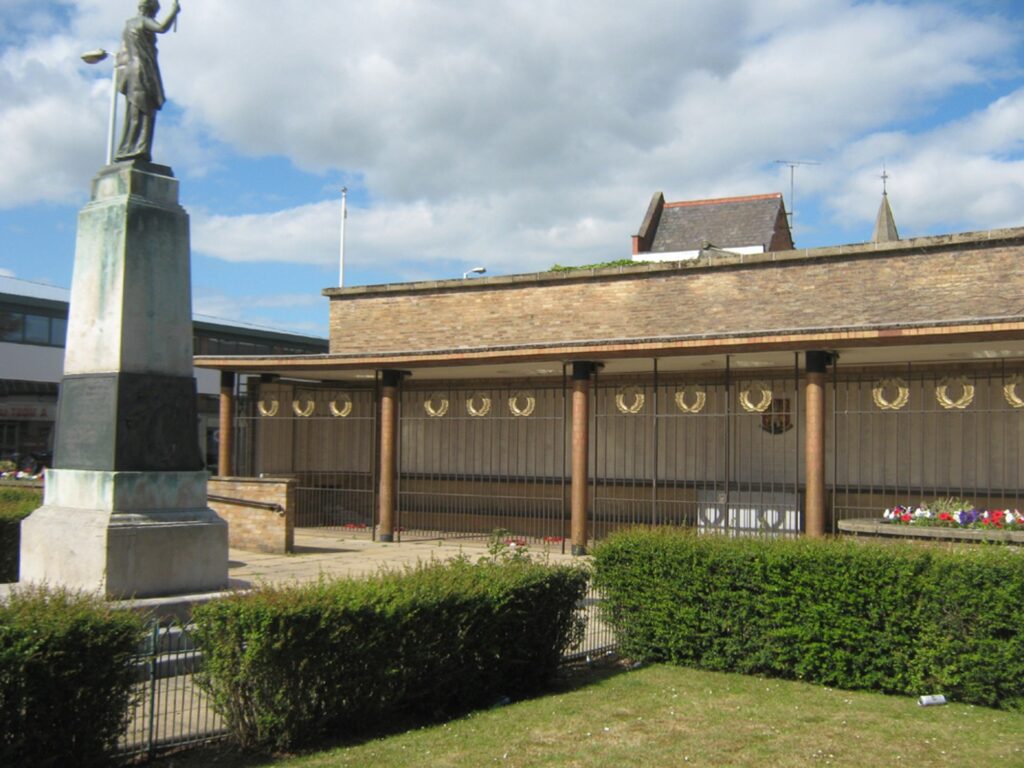
Finally, after much delay the unveiling ceremony took place on Sunday 29 May 1938. The reverse of the programme states that the main structure of the memorial has been provided by the Corporation of Northampton and the Northampton branch of the British Legion and friends had borne the cost of inscribing the 2904 names.
What is also amazing is the amount of money that was raised towards the erection of the memorials – from poor widows who had lost their husbands and sons, or from ex-servicemen who wanted to honour their fallen comrades and all at a time of rising unemployment, substandard housing and just generally dealing with the aftermath of the conflict.
Angela Malin (Oct 26)