

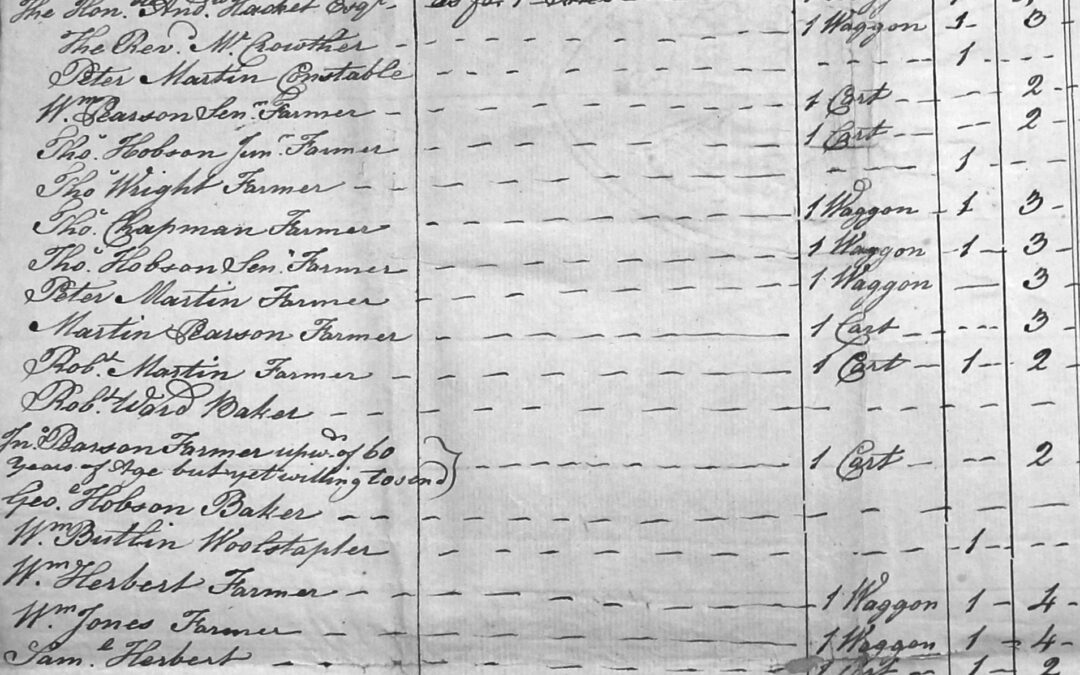
There have been militias or a homeland defence force of one sort or another in England and Wales since Saxon times, this article highlights the information available following the Militia Act of 1757.
The idea was that in the event of an invasion or of civil strife there would be an ‘armed force’ available to either support the army or, in the absence of the army due to overseas commitments, act instead of the army. Militia recruitment was not organised through Quarter Sessions but through the County Lieutenancy and magistrates and down to parish constables.
All males between the prescribed ages (18-50 from 1759-1762 therefore to age 45) were eligible to serve (these varied according to political expediency) and annually the parish constable had to draw up a list of such men. Some men were exempted if they had a disability, or a very large family, was an apprentice or a clergyman. There was a right of appeal, but you had to have a very good reason to be removed from the list. A ballot then took place and the required number of men selected for service, although some more affluent men paid members of the poorer classes to be their substitute and serve for them. The ballot itself was usually by sticking a pin in the list! This was known as pricking the men. The militia met or mustered at least 3 and sometimes 4 times a year and registers were kept of who turned up and fulfilled their obligations.
Militia men served for three years in the period 1757-1786 and five years thereafter. In peacetime they lived at home but spent two to three weeks at camp in training. During the Seven Years War, the War of American Independence and the Napoleonic Wars, most of the militia were embodied on permanent duty elsewhere than in the county where they were raised. They could not be sent overseas although some served in Ireland. While the men were on permanent duty, wives and families were paid allowances. You may find records relating to this within the Quarter Sessions or Parish Chest records like this example from Northampton St Peter’s parish – 240P/073/45. Order for relief for Edward Neal serving with Northampton Militia as substitute for Edward Williams of Farthingstone. Order to pay allowance to his wife Mary and 3 children of 4 shillings a week. Other records include the Muster Rolls or Enrolment Books for those who were chosen (often called drawn men) or their substitutes, some will give parish of origin of both men.
Additional lists were drawn up in 1798, not for recruitment into the militia but to organise a reserve of men for the defence of Britain against French invasion. This was known as ‘Posse Commitatus’ but records for only 21 villages survive for Northamptonshire, whereas there is complete surviving coverage for Buckinghamshire.
Also raised during the Napoleonic Wars were many auxiliary forces known as volunteer forces (such as at Daventry), fencibles and yeomanry. The West Northants Militia was founded at this time by John Clarke of Welton and the estate collection included a large number of lists and muster rolls of those serving, often with parish of residence. These lists can be searched online on the Northants Archives website. If you ancestor served with the militia and became entitled to a pension, then check the service records –see the guidance on the National Archives website.
Northamptonshire militia ballot lists:
The returns for 1777 are the most complete listing. This has been published by Northamptonshire Record Society and can be viewed online: www.northamptonshirerecordsociety.org.uk/ebk_militia_lists.php
FindMyPast has transcriptions for: 1762, 1771, 1774 & 1781 (most, but not all of the county), Posse Commitatus for 1798 (23 parishes only mainly Northampton-Daventry area) 1817 for Towcester area, 1819 for Daventry area,. Photocopies of the returns for 1762 and 1781 are on the open shelves.
National Archives: Some county regimental returns but these only list names, not residence.
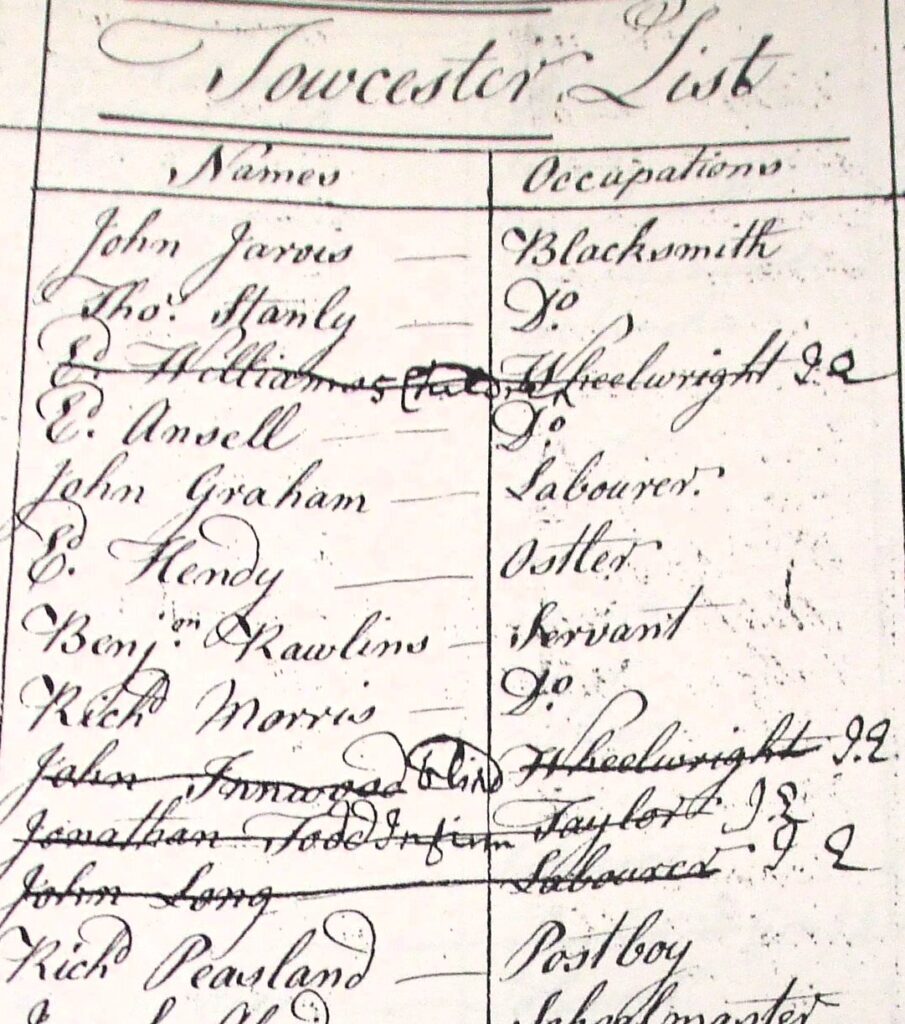
The image is for part of Towcester listing for 1781.
Further reading:
History of the Northamptonshire & Rutland Militia 1756-1919 by Major C A Markham, published 1924, can be viewed online: www.babel.hathitrust.org/ This gives details of where the regiments were stationed during that time.