

You know how it is, you’ve probably done it yourself. Wandering around The Mounts area of Northampton, a random thought suddenly came into my head! Where did all the red bricks come from? And simply because all the terraced housing, shoe factories and the places of worship are all built from red brick!
In the early years, all bricks were made by hand. Clay was dug during the winter months from October to March and it was left to the winter frosts to break it up. In the spring the clay was ‘tempered’ by turning it over by spade and by trampling under foot or hoof. The bricks would be individually made by throwing a ‘clot’ of clay into a mould. The bricks would be stacked up and left to air dry before they could be fired. In the first half of the 19th century, kilns were of a tapered rectangular construction, wide at the bottom and narrow at the top, often known as a ‘Scotch kiln’. Each held between 20,000 and 35,000 bricks. The kiln would be closed up with just a small chimney at the top. Firing would take about five days and the bricks were left to cool slowly.
More efficient kilns, known as the downdraught, were appearing by the middle of the 19th century. The idea was to get an even temperature distribution. The kiln would burn continuously with the firing zone simply moving around the chambers. Machine-made bricks, being rolled and pressed into shape, became more common after the 1860s and this allowed the kilnyards to keep up with increased demand.
It would seem that there were three main brick-making businesses in the town: at Kingsthorpe Hollow, at Buttocks Booth near Weston Favell, and on the Bedford Road. There were other names appearing from time to time in directories but these seem to be short-lived businesses.
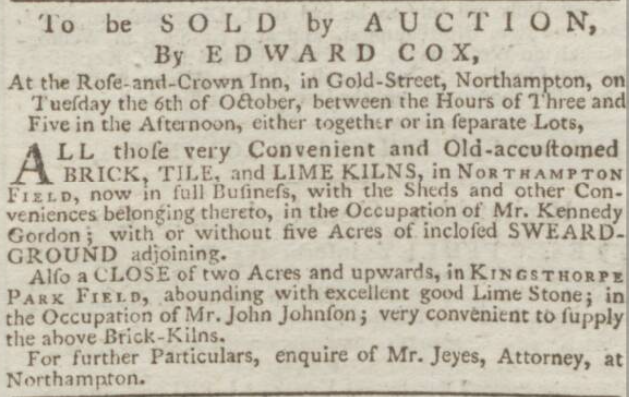
In the Northampton Mercury of 3 May 1788 Mr Kennedy Gordon advertises that he has taken and entered on the brick kilns near the New Common (Racecourse), late in the possession of Mr R Billson, deceased and where customers ‘may be supplied with good bricks, exceedingly good pantiles and plain tiles, also lime’. He would also be continuing his business in Sheep Street as a mason, stone cutter and bricklayer. His tenure was to be short, as in January and again in September 1789, the ‘old established and complete brick kilns replete with warehouses, hovels, sheds and every necessary convenience . . . in occupation of Mr K Gordon and also a close of two acres in Kingsthorpe Park Field in occupation of Mr John Johnson and very convenient to supply the above brick kilns . . .’ were offered for sale by auction. (image at top of article © British Newspaper Archive)
However, in June 1796 the following appears ‘Wanted immediately, a number of brick makers and masons. Enquire of Kennedy Gordon, Sheep Street. Northampton by whom constant employ and good wages will be given’ so he was still in business.
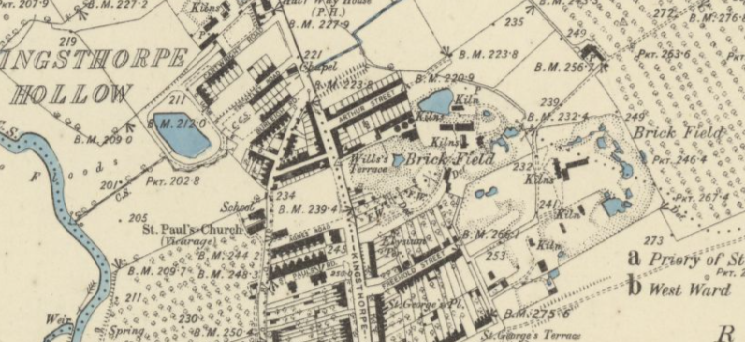
The first OS map, published in 1835, shows the kilns on the east side of the road to Kingsthorpe and these also appear on the 1880 map (above). On the latter map there are also kilns shown on the west side a little higher up. This possibly relates to the close occupied by John Johnson (as above).
A directory of 1841 records a Robert Elliott at Kingsthorpe, Charles Ireson in Bath Street and William Johnson at North End. This is confusing, as an auction notice in 1842 mentions a brickyard near the Racecourse in the occupation of Thomas Johnson and another newspaper advert gives B Lucas taking over from a William Dunkley ‘at Kingsthorpe brickyard’. Obviously, the brickworks were all separate entities but it makes it hard to trace ownership and tenancies.
In 1850 the following advert appears: ‘To be let: All those brick kilns yard and situate near the Raceground, Northampton late in the occupation of Mr George Thomas Master. The yard, under clay, and premises to be used, dug and managed in the usual and customary manner.’
By 1866 John Clarke was adverting his brickworks and later in 1875 John Wills was operating a steam powered brick making business in Kingsthorpe Hollow.
Adjacent to this was the second brickworks, now owned by Messrs Phipps and Co, brewers in the town, and managed by Messrs Rixon.
In 1886 the Steam Brickworks in Kingsthorpe were put up for sale and this included two brick kilns. The latter was taken over in 1894 by Greenough, Rand and Sherwell. The works closed shortly after 1910. The works on the left-hand side appear to have later been in the occupation of William Johnson, Thomas Johnson, Charles and later J Ireson. By 1927 the site was disused.
By 1819 it would seem that a further quarry and brick works had appeared in the Buttocks Booth area of Northampton (north of Weston Favell towards Moulton Park) as this freehold close and brickworks was to be sold by auction in August of that year. In 1832, George Pell had taken over the Buttocks Booth Inn and adjacent brick kilns. Common bricks of good quality were selling for 3s 3d per hundred. The business was not successful at on 7 May 1835, it was put up for sale by auction as George Pell was bankrupt..
Not to be kept down, George Pell announced in 1842 that he had entered upon the Kingsthorpe Lodge quarries and kilns lately carried on by Mr W Dunkley. He had also commenced his coal trade at his wharf at Bridge Street, Northampton. But four years later, the Mercury has the following advert ‘Buttocks Booth near Northampton. To be sold by auction on 7 May 1846, on the premises at Buttocks Booth, the property of Mr G Pell (who has declined the innkeeping and brick making businesses) viz three clay mills, tile machine, 60,000 bricks, tiles, squares, brick kiln, sheds etc.’ Further owners do not appear in the directories. The site was disused by 1883 and lay dormant until after World War 1 when A Glenn and Son opened a works here under the name of the Weston Favell Brick and Tile Co. It closed about 1941.
In 1828 William Butcher, brick and tile manufacturer and publican of the Ship Inn, Mercers Row, Northampton advertised in the Mercury that ‘since his commencement in the business he has on sale at his yard near to Midsummer Meadow, bricks and tiles of every description’. By 1832 J C Barratt had taken over the business which by now had become known as the Vigo Brickworks. Thomas Billingham was there in the 1841 directory.
The business was offered for sale in 1885: The business premises include one large 14 chamber kiln, each holding 18,000 bricks with a 235 ft shaft arising therefrom, having separate flues from drying sheds, three other ovens, burning together 115,000 bricks, two drying sheds, with six furnaces, and other flues and chambers. In 1894 the company changed its name to The Vigo Brick, Tile, Land Investment and Advance Co. Ltd. The works closed shortly after 1917 and the site became a tannery.
As for the red bricks in the article’s title, they could have come from any three of the brickworks. The red colour depends on the chemical and mineral content of the clay. The colour can also be controlled by the temperature of firing.
But do spare a thought for the local carrier and his horse who had to cart all the bricks from the brick works to the building sites!
Bibliography:
Northampton Mercury
R O’Rourke 1970: Some Northamptonshire Brickworks CBA Group 9 Bulletin (online)
Trade directories
Ordnance Survey maps
AM June 2026